
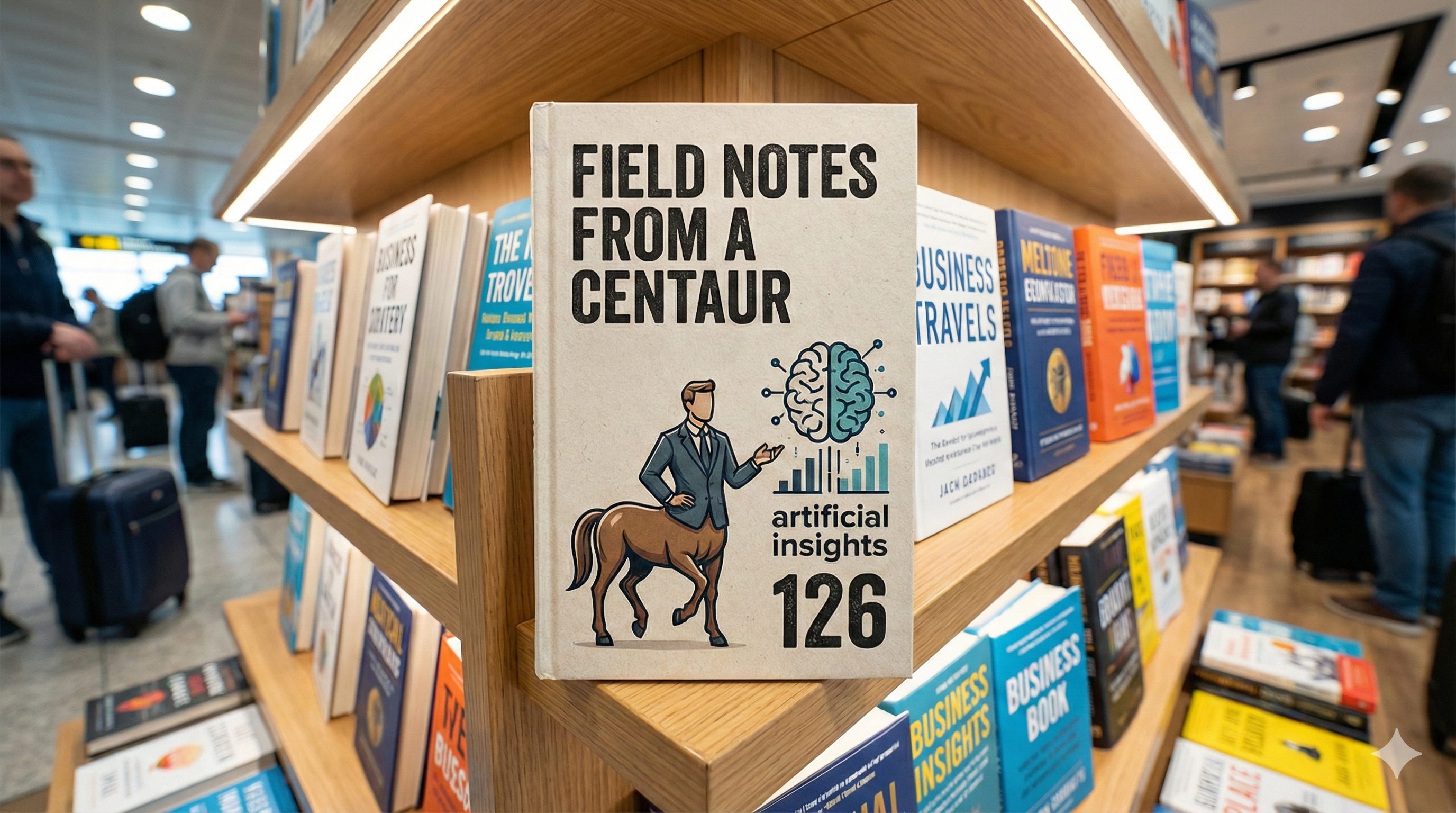
Welcome back to Artificial Insights, your weekly attempt to make sense of scattered ideas.
If thinking refines ideas, creating brings them into form, building makes them functional, deciding chooses their direction, organizing keeps them coherent, and living is where it all touches the ground – then connecting is how the fragments become a system.
This is the seventh and final chapter in my series documenting how I actually work with AI, as co-created with multiple language models that I spend time with. It explores the dimension where everything converges: seeing relationships, tracing patterns, and making sense of how scattered pieces fit together.
I’ve learned that connecting with AI isn’t necessarily networking or communication in the traditional sense. It’s about using intelligence as a lens to see inside systems, relationships, and consequences that remain invisible when you’re stuck inside them. When I use AI to connect ideas across domains, synthesize narratives from scattered work, or interpret signals for underlying shifts, I’m building a map of how things relate.
These field notes document how I connect with AI. The notes themselves are co-created, mostly by asking ChatGPT to review its memories of our exchanges and surface the patterns underneath. What emerges is a practice of seeing through shared intelligence: not predicting the future, but perceiving the present more clearly.
How I connect with AI:
Personal reflection and clarification: When I’m uncertain about a feeling or decision, I write a short reflection and let AI restate what it sees. Its summaries reveal patterns in tone and reasoning that I might miss. The act of being mirrored helps clarify thought without judgment.
Narrative synthesis: When pulling together projects or threads of writing, I ask AI to identify overarching motifs—continuity, transformation, emergence. It reveals the connective tissue between scattered ideas. The resulting synthesis brings coherence to work developed across time and context.
Pattern recognition across fields: I use AI to trace structural similarities between domains—how feedback loops appear in both ecology and economics, or how adaptation works in culture and code. These correspondences deepen my appreciation for how systems evolve across scales.
Concept cross-referencing: I combine ideas from separate disciplines—such as design, psychology, and computation—and let AI explore their shared language. It reveals analogies that make complex systems more intelligible. The process transforms separate lines of thought into a network of insight.
Foresight experimentation: I use AI to imagine how today’s early signals might unfold into different futures. It extends the logic of trends, exploring what happens when they intersect or accelerate. The exercise keeps speculation grounded, helping me think beyond the immediate without losing realism.
Connecting becomes possible when you treat AI as a companion for seeing relationships, not just retrieving information. At scale, hybrid intelligence becomes a lens for connection. It allows me to trace the relationships that link ideas, disciplines, and times. Seeing patterns is the final gesture of the centaur mind – not prediction, but perception sharpened through companionship.
Until next week,
MZ
Quick Links:
This is awesome: Remarkable-Trick-177 on Reddit is training an LLM only on texts from the 1800s.
Someone made a language-model-based calculator powered by GPT-5.2.
Gemini’s Text-to-speech capabilities (via Carlos Ocampo)
Aristotle by Harmonic is a math AI (via Joel and Guilherme Kujawski)
Our agents might also read poetry! Adversarial poetry. Poetry that hacks LLMs. (via Frits Kosovosky)
A packed interview w Arthur Mensch, CEO Mistral.ai (via Gisele Legionnet-Klees)
The Future is Text Files (16 min)
AI agent skills are just… text. (Via Richard Wolfe)
Dense conversation about the shape of AGI between Shane Legg amd Hannah Fry (53 min)
Bernie Sanders being so involved in the AI discourse was not on my bingo card for 2025 (15 min)
I wish other politicians would pick up on this.
If Artificial Insights makes sense to you, please help us out by:
📧 Subscribing to the weekly newsletter on Substack.
💬 Joining our WhatsApp group.
📥 Following the weekly newsletter on LinkedIn.
🦄 Sharing the newsletter on your socials.
Artificial Insights is written by Michell Zappa, CEO and founder of Envisioning, a technology research institute.
Thanks for reading Artificial Insights! Subscribe for free to receive new posts and support our work.