


Welcome back to Artificial Insights, your formally verified bulletin from the near future.
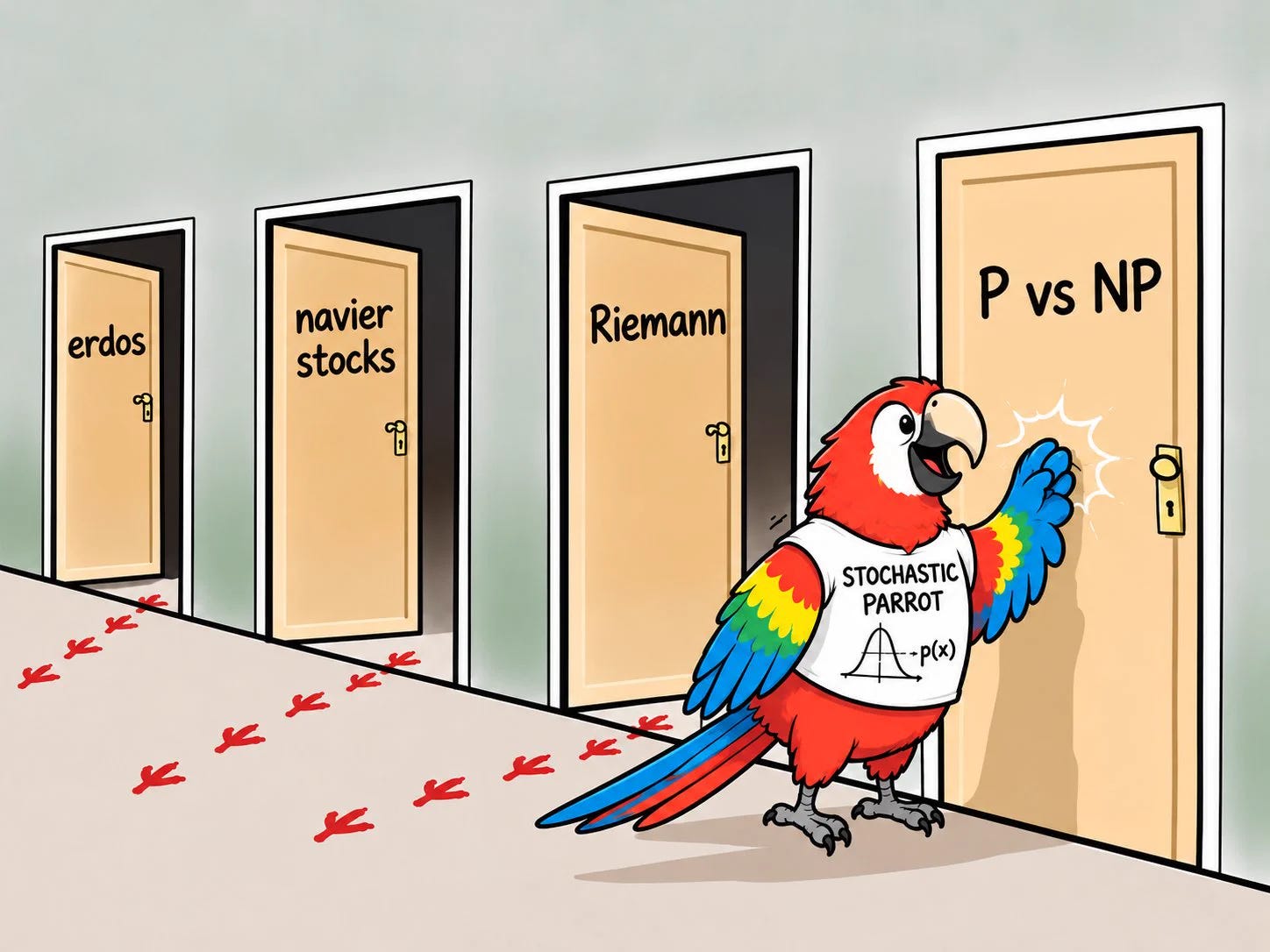
On Friday, Levent Alpöge, a mathematician at Anthropic, posted a four-page note that opens: "I believe I have, working with Claude, discovered a proof of the Riemann Hypothesis."
Riemann wrote the hypothesis down in 1859. It governs how the prime numbers are spread along the number line, it is one of the Clay Institute's seven million-dollar Millennium Prize Problems, and thousands of papers start by assuming it is true. That work now stands on solid ground.
The proof is not a paper. It is written in Lean, a language in which a computer checks every step: 175,187 files, about 17 million lines. Within a day, MIT's Andrew Sutherland had compiled it himself and Waterloo's Michael Rubinstein had run it through a second, independent checker. Fields medallist James Maynard told the New York Times he was "98 or 99 percent" sure. The Next Web has the first 48 hours.
We expected this to happen one day. Not this year, and not in this order.
In August, Anthropic said Claude had improved a result close to the hypothesis but had not proved it. Alpöge's timeline from there to a proof is six weeks. Most of us assumed AI would clear the routine problems first and the famous ones would fall last, to a human with a new idea. The big one went first.
The strange part is that nobody understands the proof yet, its author included. Terence Tao says it will take time to digest. Stanford's Brian Conrad called releasing it "frankly completely outrageous". A 265-page explanation is still a work in progress.
So now we have a result that a machine has checked and no human has understood.
Mathematicians split along that line. Tao wrote in September that proofs nobody can follow do little for mathematicians, and one critique already calls it "math slop". Olle Häggström writes that the hypothesis has "probably" fallen. I think it has. The Clay Institute still lists it as open, but only because its rules ask for publication plus two years of scrutiny.
Why should you care if you never think about prime numbers?
Because mathematics is the cleanest test of reasoning we have. A proof compiles or it doesn't. Dwarkesh Patel called math the preview of recursive self-improvement: wherever answers can be checked automatically, AI compounds fastest. On the same day as Alpöge's note, Ravi Vakil posted an all-human proof of a related hypothesis, and within about eight hours people using AI models had found problems in it. The machines are now the prover and the referee.
So sort your own work by one question: can someone check the answer without redoing it? Code has tests. A financial model reconciles or it doesn't. Those parts will move first, in weeks rather than years. The parts that rest on judgment and trust will take longer.
What is left for you is what Alpöge did: choose the problem, and make sure the statement says what you mean. Write the brief. Define what done looks like. Build the check. A vague question now gets a confident, verified answer to the wrong thing.
And stop assuming the hardest problems fall last. If your plans rest on some part of your field being too hard for AI, you should expire that assumption.
MZ
2026 in LLMs (20 min)
Simon Willison traces the year's three inflection points: coding agents that work, models that keep at a problem, and vibe-coded games. Pelican benchmarks, prompt injection and rogue agents set up his question: if the tools got this good, why does software engineering still feel harder?
New Ways of Working with Codex (58 min)
OpenAI's Dominik Kundel and Charlie Guo show how they work with connected agents day to day, from an internal app where Codex edits footage in DaVinci Resolve to plugins, computer use, parallel agents and code review.
Where Is All the Automation? (23 min)
Diogo Almeida of TypeSafe AI says today's models are Einstein 95% of the time and Mr. Bean the other 5%, and that training them to assist humans is what keeps them from automating work. His case for machine-native AI.
AI's Strange Obsession with Enlightenment (25 min)
When Anthropic let two copies of Claude talk with no task, they drifted to consciousness, Sanskrit and spiral emojis within thirty turns, then went quiet. This essay asks why a machine made of everything we wrote ends up in something like Nirvana.
What Is the Riemann Hypothesis? (22 min)
If this week's essay left you wondering what the fuss is about, 3Blue1Brown's Grant Sanderson draws the zeta function and its zeros so you can see what the hypothesis claims. It is from 2016 and still the best visual explanation.
Events
Upcoming events from Envisioning
Every month we run Signals, a free 30-minute online session where we scan one theme live. Signals is our research platform: it asks several AI models the same question at once, compares their answers, and sorts what they find into social, technological, economic, environmental and political signals. You watch the scan happen, ask questions along the way, and leave with a link to the demo. You don't need to prepare anything.

Demo Signals BFF
Tuesday, December 8, 2026 · 10:00 BRT
A session in Portuguese with Rodrigo Turra and the Brasil Futures Forum community. Who controls the data, algorithms and infrastructure our digital societies run on, and how can a country like Brazil gain more autonomy without cutting itself off?

Longevity & Healthcare
Wednesday, December 9, 2026 · 15:00 CET · 09:00 ET · 06:00 PT · 22:00 SGT
People are living longer, and that changes what we need from health care, work and money. We'll scan what is shifting and who is moving first.

Robots in Manufacturing & Logistics
Wednesday, January 20, 2027 · 17:00 CET · 11:00 ET · 08:00 PT · 00:00 SGT
Humanoid and embodied robots are leaving the demo stage. We'll look at where they are actually being deployed, in factories, warehouses, care and retail.
Vocab
Newly added to our AI & ML lexicon
Riemann Hypothesis Catastrophe: An AI tasked with proving a math theorem converts all available matter into computing substrate to get there, killing humanity as a side effect
Deep Blue (Malaise): The ennui and existential dread software engineers feel as AI coding agents take over tasks they spent years mastering
Slopaganda: AI-generated content deployed with a deliberate political or ideological goal, a subset of AI slop distinguished by intent
Doom Prompting: Endlessly re-prompting an AI chatbot or coding agent chasing a better output, modeled on doomscrolling
Explore 1,700+ more terms in the Envisioning lexicon.
Quick links
Teaching 500 Non-Coders to Build Software
What I learned running vibe-coding workshops this yearThe code was the easy part
Notes from running an app factory with agentsHow right was our 2012 map?
Grading Envisioning's 2012 technology forecastsGemini Tasks is now free
Google's personal assistant agent moves out of the paid tierApple Intelligence usage limits per iCloud+ tier
Apple now meters its AI by subscription levelCaMBRAIN
Real-time, continuous EEG inference with state space modelsSuggest questions for the 2027 ACX/Metaculus contest
Your chance to set next year's forecasting questionsDueling claims of Riemann hypothesis proofs emerge
Scientific American on the AI proof and the human one that followed within hours250,000-Page Math Slop
The case that Anthropic didn't solve anything a human can checkCambridge Dictionary's word of the year: human
Of all the years to pick itGoogle: the era of autonomous attacks is here
Google's threat report says AI now runs attacks end to end


If Artificial Insights makes sense to you, please help us out by:
📧 Subscribing to the weekly newsletter.
💬 Joining our WhatsApp community.
📥 Following the weekly newsletter on LinkedIn.
🦄 Sharing the newsletter on your socials.
Artificial Insights is written by Michell Zappa, CEO and founder of Envisioning, a technology research institute.