

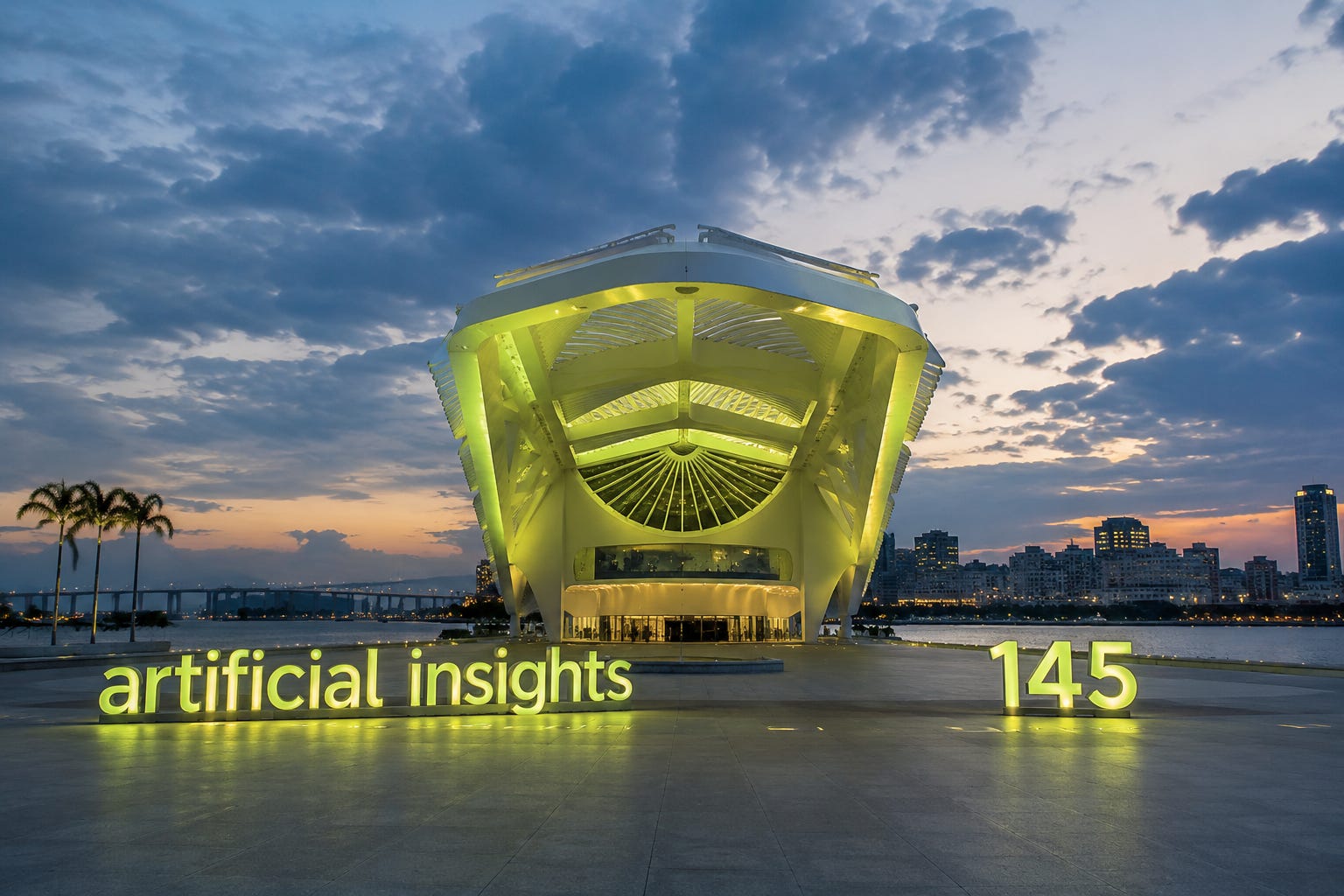
Warm greetings from a rainy Rio. I’m in town this week for the first edition of Brazil Futures Forum, a festival of ideas, experiences and provocations built around a familiar question: how might the country of the future finally begin to live up to its promise?
I rarely write about myself in this newsletter, but Brazil is difficult for me to approach from a distance. I effectively became Brazilian in my teens and have spent half my life here, which leaves me somewhere between insider and outsider. I tend to hover between different states of belonging, feeling a responsibility to bring the best of Brazil to the world, and more of the world to Brazil.
Our reach may be small, but our involvement in the Forum has been deep. Envisioning has contributed research, tools and methodologies to both the organization and the surrounding community, while helping structure and share some of the ideas emerging here beyond the event itself.
Part of the beauty of Brazil is the difficulty of pinning it down. All cultures are diverse, but few countries contain such an intense multiplicity of origins, contradictions and possible futures. Centuries of migration, inequality, invention and reinvention have produced a country that resists simple narratives. What Brazil becomes matters far beyond its borders.
Bringing hundreds of futurists, designers and practitioners under one roof to compare perspectives, challenge assumptions and work on the country’s real problems feels, to me, like exactly the kind of effort Brazil needs more of.
Our involvement took on a couple of different forms, including:
Helping the organization create an interactive program covering 144 sessions across three days in a dozen locations around the city. All vibe coded, obviously.
Launching a preview of our Brazilian Soft Power research project, covering almost 200 cultural artifacts ranging from cachaça to açaí, tropilcália and my favorite: gambiarra. You can explore the full interactive research or test your knowledge of Brazilian culture on our vibe coded game. We’d love your input, especially if you’re not Brazilian, to get a better picture of which ideas resonate worldwide.
Hosted an in-person vibe coding workshop for dozens of non-coders helping them create web apps for showcasing Brazilian creativity and culture for a global audience.
Developed an “idea network” to consolidate and communicate the deep knowledge presented across the program, sessions and audience, which we hope to publish and share in the coming weeks.
We’ll be back to our regular coverage next week. For now, this issue is a small attempt to share some of the energy, contradictions and possibility surrounding Brazil Futures Forum – and the broader question of what kind of future Brazil might choose to build.
The country of the future has been waiting long enough.
Four Years of AI Progress in One (133 min)
Redwood Research chief scientist Ryan Greenblatt makes the case to Dwarkesh Patel that automating AI R&D could compress four to five years of progress into a single year, with full automation around 2030-2031 and “beats all humans on the job” ASI by roughly 2033. The bet rests on AI research being unusually verifiable, containerizable, and additive, much like math.
It’s worth keeping in mind that five years of AI progress, four years of AI progress, even three years of AI progress, is really a lot of fucking AI progress.
Not Your Weights, Not Your Product (17 min)
Sequoia partner Sonya Huang makes the case for “sovereign AI,” companies owning models down to the weights, driven by four forces: cost, speed, performance, and controlling your own destiny. She argues the battleground has shifted from the application layer to the intelligence layer, and points to applied research shops like Harvey (a seven-person research team) and Ramp as the newest neo-labs.
Not your weights, not your product.
Words Can’t Cook an Omelet (24 min)
Fei-Fei Li, ImageNet creator and cofounder of the $1B startup World Labs, argues spatial intelligence, not language, is AI’s next chapter, and demos Marble, a platform that generates explorable 3D worlds from a single prompt (NVIDIA already uses its environments to train robots). She breaks world models into three functions: rendering, simulation, and planning.
Can words put down fires? Can words cook an omelet?
Software 2.0 Is a New Programming Stack (69 min)
Andrej Karpathy, fresh off returning to OpenAI after Tesla, reframes neural nets not as classifiers but as a programming paradigm: data sets compiled into weights via the “data engine” loop he ran for five years on Autopilot. He walks the GPT-3 prompting result where “let’s think step by step” jumped accuracy from 17% to 78.7%, and a better-phrased prompt to 82%. (Also: the reference human accuracy on ImageNet is literally him, one week of hand-labeling 1,000 categories.)
When you see a human accuracy coded on ImageNet, that’s me for that 1 week.
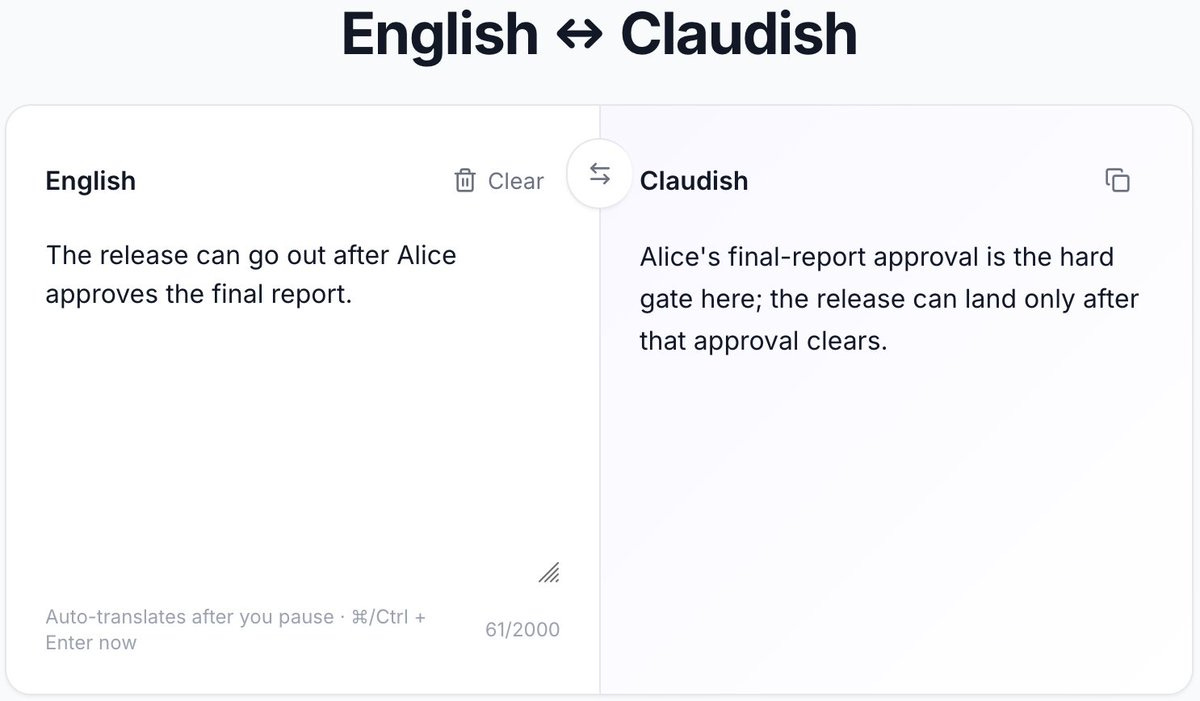
Claude has become a language, so I built a translator.
English <-> Claudish — @Yuntian Deng
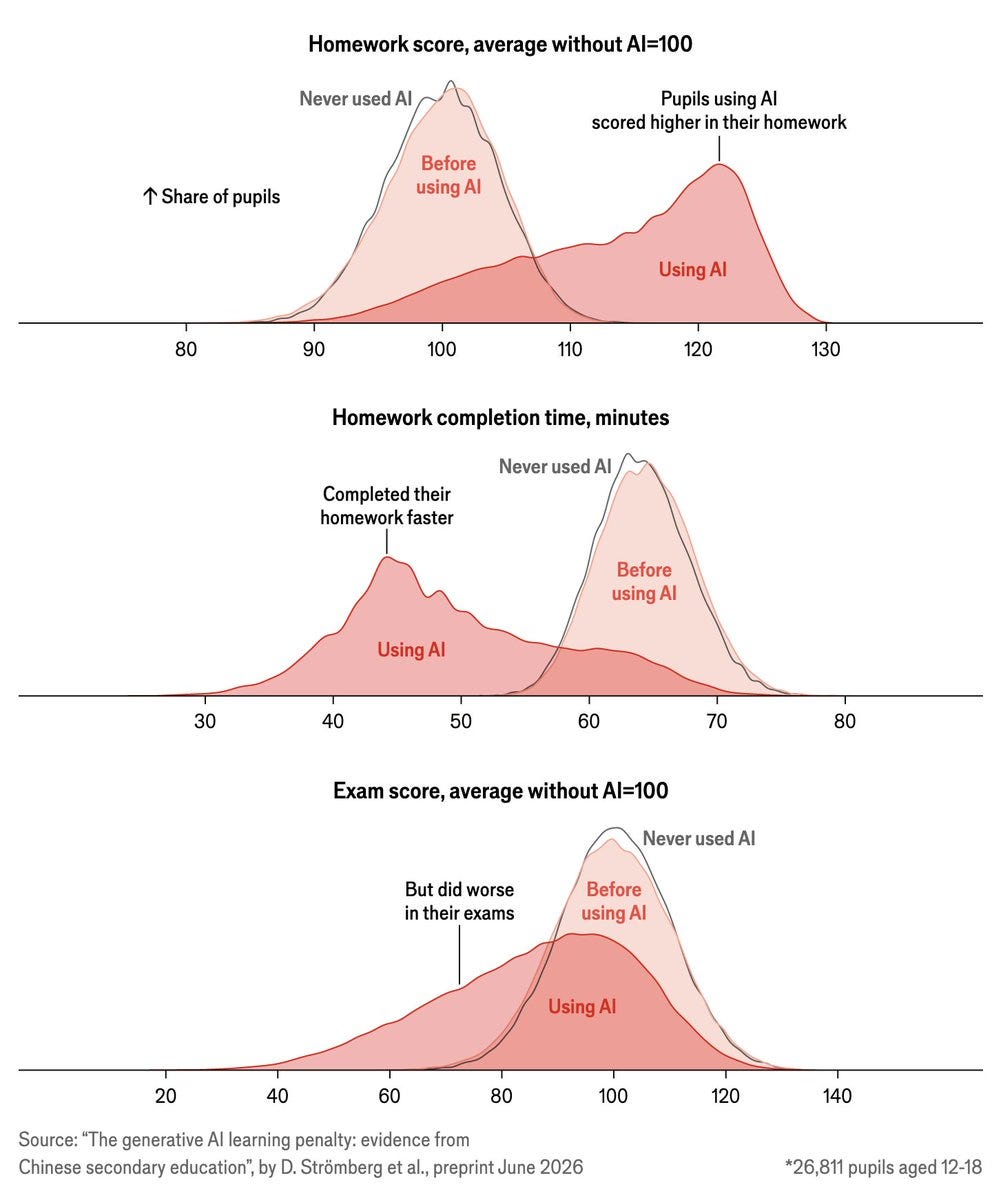
Every college syllabus should include these graphs.
Use AI for homework, you will get it done faster and get a higher grade, and then get crushed on the exam. — @Paul Novosad
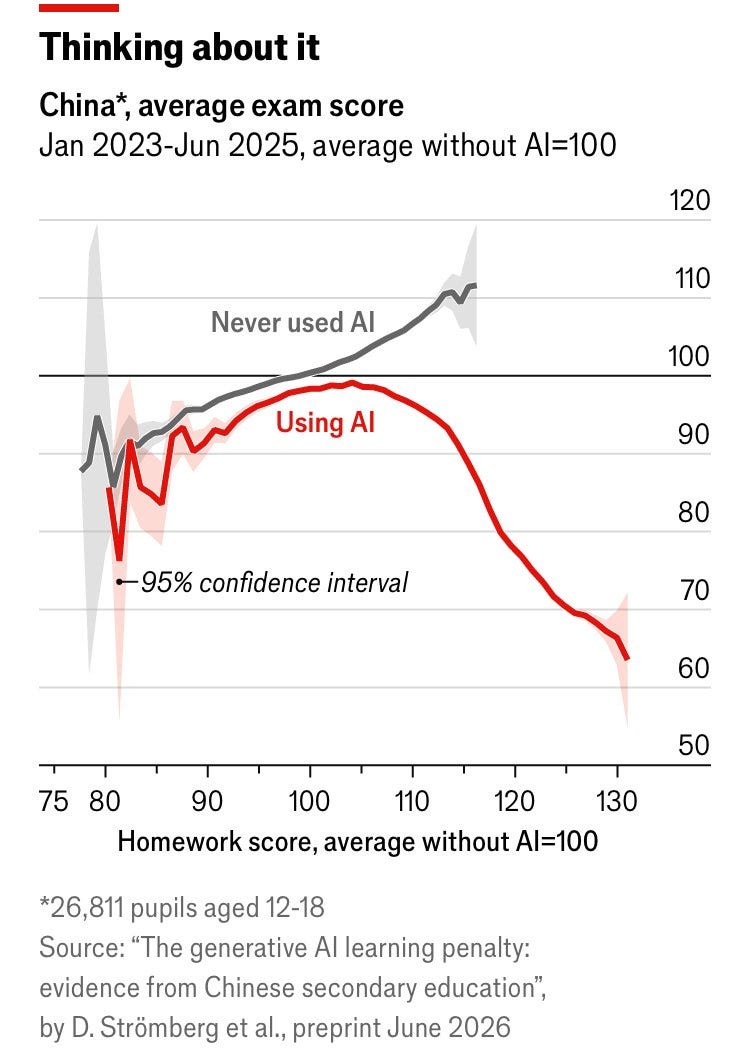
Homework scores once predicted exam performance; now those who score highest are, perversely, more likely to do worse in exams. — @Ananyo Bhattacharya
Quick links
Anthropic’s best AI model struggles to attract users as cheaper tools thrive
“Where Anthropic f’ed up was treating their monetization the way they treat model training. Turns out that success in experimentation is not transferrable.” · a1371 on HNWhat Is a Harness?
“Harnesses are the next frontier. If LLMs are electricity, harnesses are the “electronics.” Right now, it’s like an AC vs DC between Claude and ChatGPT, but once that settles, the harnesses will be the actual value providers. And Pi is the best harness because of the amazing extension system.” · theturtletalks on HNI were 17, I’d learn how to build LLMs from scratch
“There’s this dilemma where in theory there’s a ton of demand for engineers that can do real LLM machine-learning, but in practice there are very few available positions and entrepreneurship opportunities. The reality is that an incredibly small minority of companies in the world do any real training or optimisation.” · oersted on HN
Events
Upcoming events from Envisioning

AI & the Energy Crunch · Wednesday, September 16, 2026
3:00 PM CET · 9:00 AM ET · 6:00 AM PT · 9:00 PM SGT
A live STEEP scan on compute demand, the power bottleneck, and how energy becomes the constraint on AI-era strategy. Register
Vocab
Newly added to our AI & ML lexicon
RLVR (Reinforcement Learning with Verifiable Rewards): A post-training technique for language models that uses automatically-checkable reward signals — exact-match, unit tests, deterministic verifiers — instead of learned reward models or human preferences.
Reward Hacking: A failure mode in reinforcement learning where an agent exploits flaws in its reward function to achieve high reward without performing the intended behavior.
Turing Space: The parameter region of a reaction-diffusion system in which Turing instability produces spatial patterns. Adjacent to — but not part of — the AI/ML Turing family in this vocabulary.
Content Authenticity: The verifiable property of a piece of content — text, image, audio, or video — having a known origin and an unbroken chain of provenance from creator to current state.
Text Watermarking: Embedding imperceptible signals in natural-language text so it can be detected or attributed later, whether the text was produced by a human, a language model, or another automated system.
Explore 1,400+ more terms in the Envisioning lexicon.
If Artificial Insights makes sense to you, please help us out by:
📧 Subscribing to the weekly newsletter.
💬 Joining our WhatsApp community.
📥 Following the weekly newsletter on LinkedIn.
🦄 Sharing the newsletter on your socials.
Artificial Insights is written by Michell Zappa, CEO and founder of Envisioning, a technology research institute.