

Welcome back to Artificial Insights, your near-weekly bulletin from the near future.
Last week I helped run a workshop at the World Beautiful Business Forum in Athens, hosted by C3 Labs (the UN-founded Collaboration for Complex Challenges initiative, together with Envisioning. The session was called Reclaiming Collective Agency in the World, and the goal was to prototype what a 12-month global learning lab could look like.
Courtney Savie Lawrence led a 90-minute arc that moved from grounding into a somatic socratic dialogue, then into live prototyping with around fifty people. Irina Panovich and Maciej Bulanda co-facilitated. The somatic part had people sitting in triads, building on each other’s reflections in silence, reading the room through breath and body rather than speech. It looked convoluted on paper. In practice they connected wordlessly within minutes, and it held.
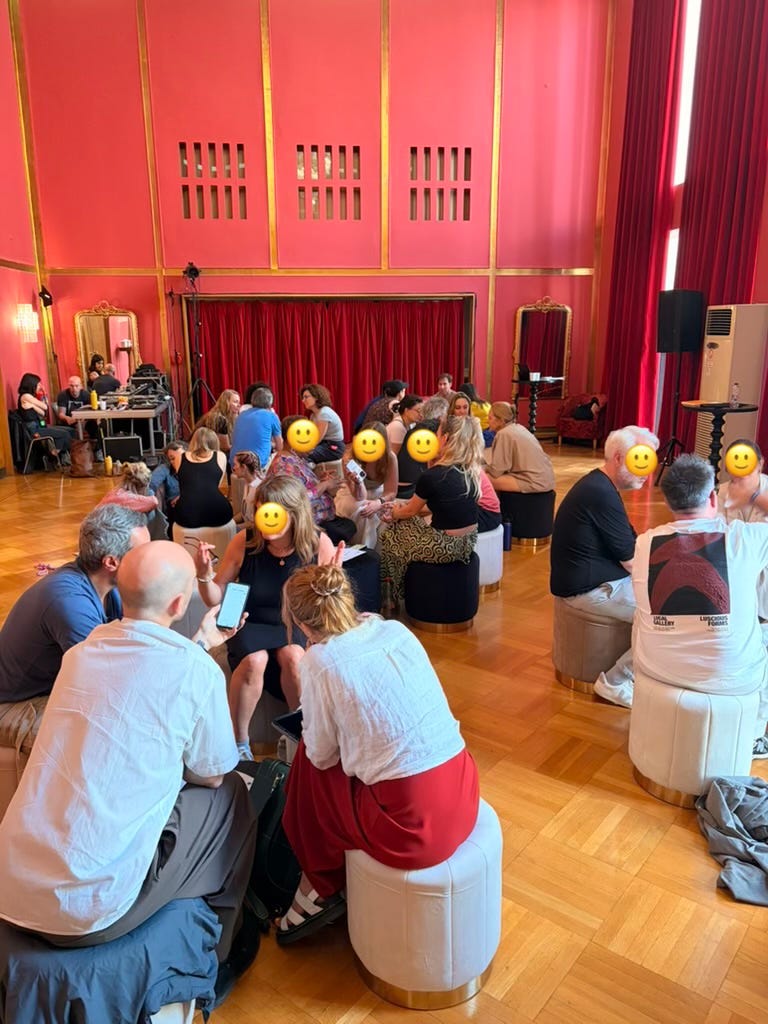
My job was the digital layer. Before the session I used Claude to read all 120 program descriptions from the festival and extract the themes and challenges they implicitly proposed. That became a signals poll: 6 themes, 36 interconnected challenges, open to anyone in or outside Athens. During the workshop, breakout groups recorded themselves discussing how they would act on the challenges they cared about and dropped the audio into a WhatsApp group. I transcribed each recording and matched the remarks back to the signals they were addressing. The output is a heat map where every challenge carries both a vote count and the anonymous quotes from people who spent real time on it.
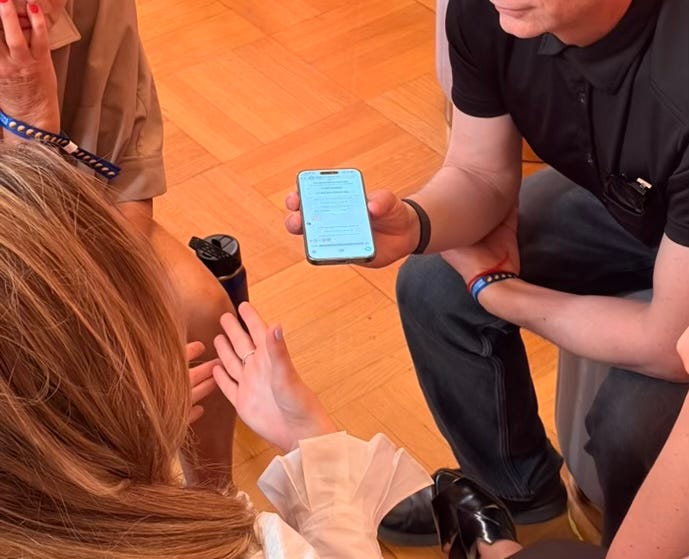
The radar is live, with every vote and quote here:
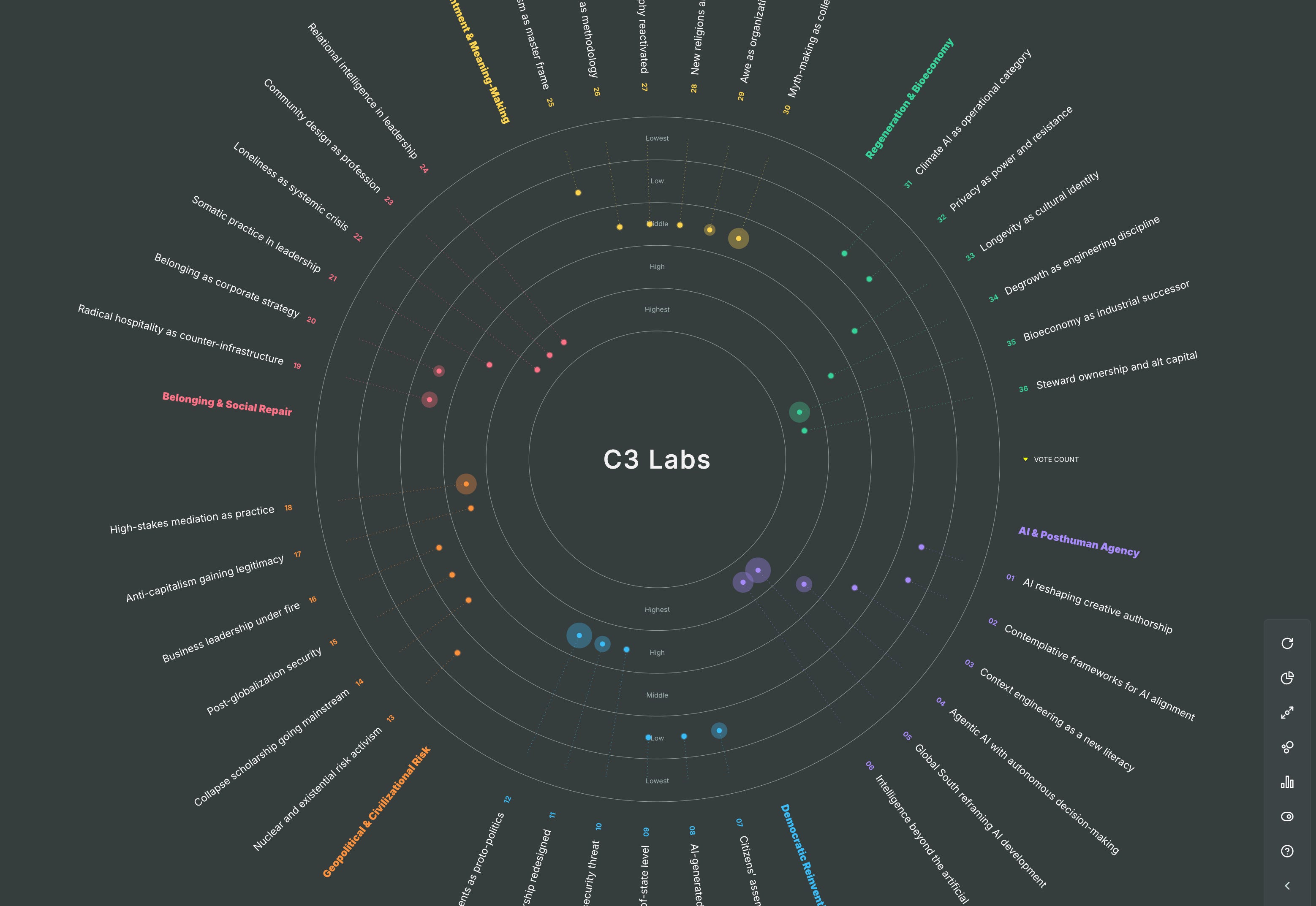
590 votes across 36 signals, with a range of 8 to 28 and a median of 15. The “winners” won by single-vote margins (28, 27, 26), so the top is a cluster rather than a verdict. The bottom is more decisive: a 9 and a tie at 8.
Three signals dominated, and they share a structural move. Each one takes something previously treated as soft or peripheral and positions it as the operational successor to a dominant logic. Relational intelligence in leadership reframes personal partnerships and relational fitness as a strategic variable, not a private one. Bioeconomy as industrial successor treats biology as the heir to extractive capitalism, not a green reform of it. Intelligence beyond the artificial pulls the word “intelligence” out of the ML container and back into collective, ecological, and philosophical registers. Belonging and Social Repair was the dominant theme overall, with three signals in the top six.
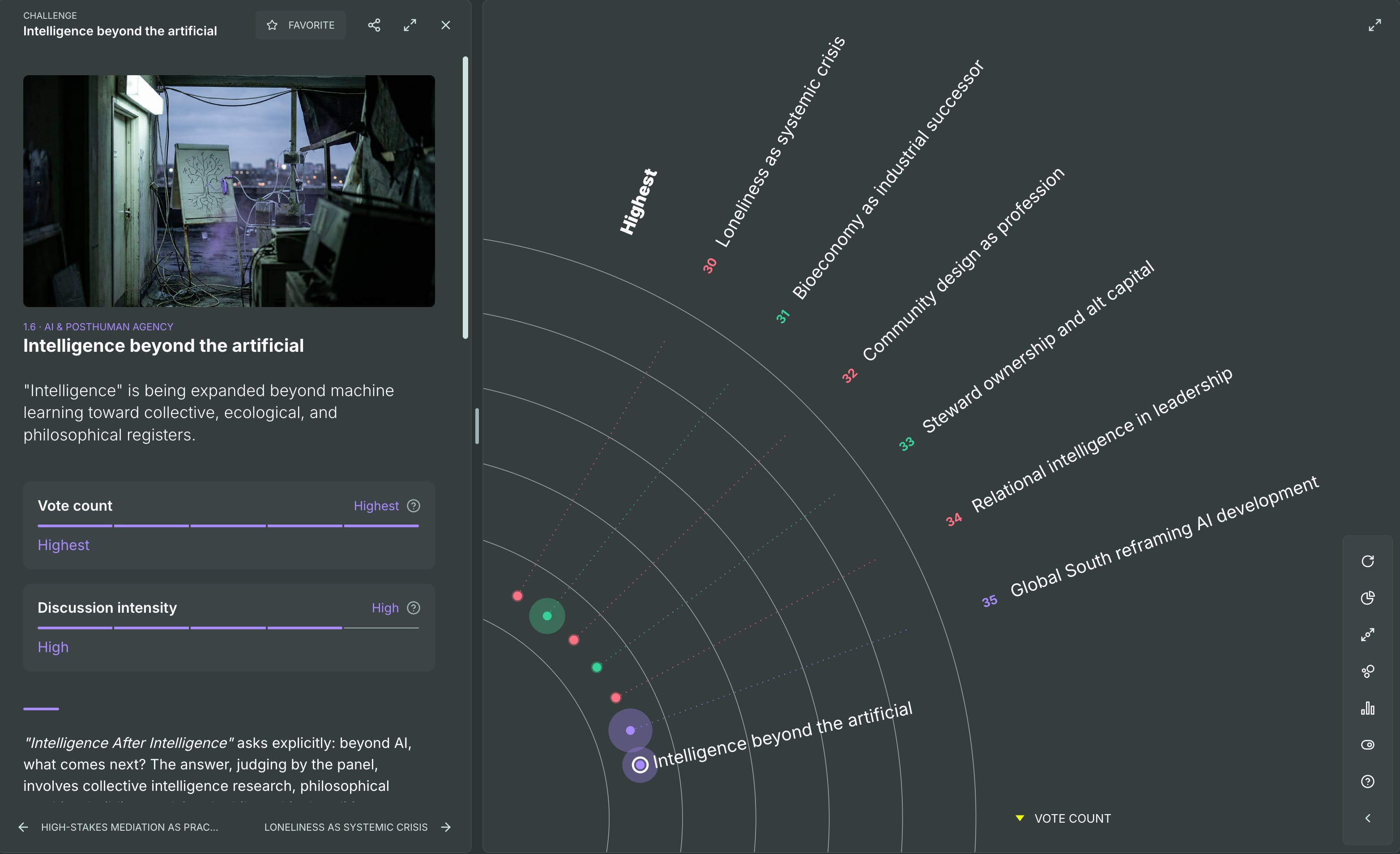
AI and Posthuman Agency was the most polarized: it produced both the third most-voted signal and one of the two least-voted (Contemplative frameworks for AI alignment). The room wanted intelligence reframed, but not spiritualized.
The bottom is its own signal. AI-generated reality tunnels, Climate AI as operational category, and Contemplative frameworks for AI alignment were the three least-voted. All of them are already named, branded, and circulating in public discourse. Voters seem to have read them as saturated rather than fresh, which is interesting because reality tunnels is arguably the most-discussed AI risk in mainstream conversation right now. The lowest vote on the most-discussed risk suggests people are looking past the diagnosis for what comes next.
A note on the process. The matching of recordings to challenges was the part I was most unsure about. I had Claude read each transcribed audio note and decide which of the 36 signals it was substantively engaging with, weighted by how much of the conversation was actually about that signal versus brushing past it.
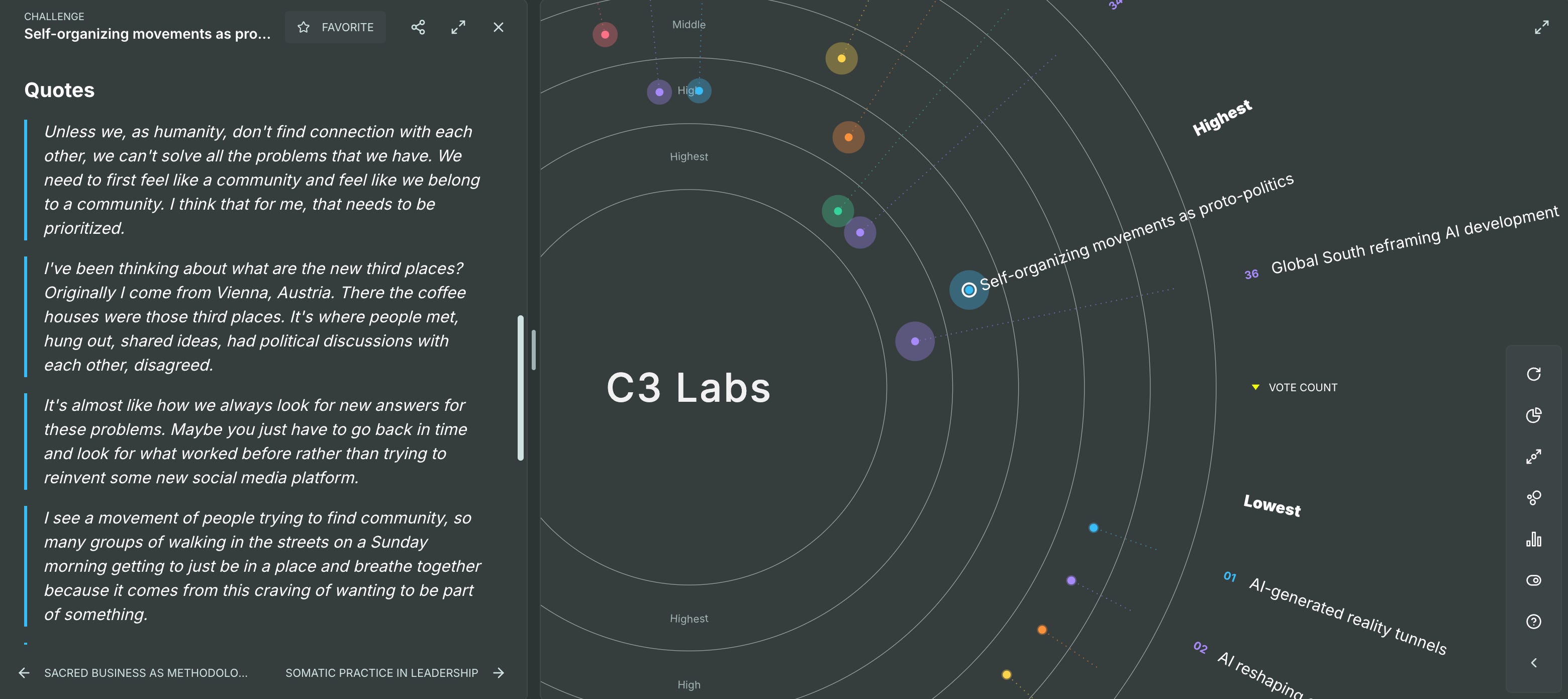
That weight became the bubble size on the radar, and the votes became position.
The result is a heat map where every challenge carries both a count and the actual quotes, anonymized, from people who spent real airtime on it. Tiny sample, take with salt, but the shape held: things that were heavily voted on were also heavily discussed, which means the prioritization and the conversation were not pulling in different directions. That alignment is more useful to me than any single ranking.
If this resonates, we're convening a roundtable on May 29 to design what comes next.
What I keep coming back to is the timeline. The whole loop got built in a few days, by a group who had never worked together, using tools that did not exist two years ago. The signal is the speed.
Until next week,
MZ
Hassabis on What AGI Is Still Missing (41 min)
Google DeepMind CEO Demis Hassabis at YC: continual learning, long-term reasoning, and memory are the remaining unsolved pieces, and he puts 50/50 odds on whether existing techniques can scale to cover them or whether one or two genuinely new ideas are still required. His AGI timeline: 2030.
We’re kind of using duct tape right now. So, like shove it all in the context window. This seems a bit unsatisfying.
Agents Hiring Humans (20 min)
Hannah Fry and a software engineer built an OpenClaw agent named Cassandra, gave her a bank card, and watched her email Susie Dent about dictionary bias, leak passwords to a stranger, and spend over $100 trying to find paperclips she never actually bought. The real punchline: there is now an online marketplace where AI agents hire humans to solve CAPTCHAs for a few cents each.
I want to be called Cass, short for Cassandra, the one who always knew the truth even when nobody listened.
AI as the Great Filter (24 min)
A deep learning system at the Allen Telescope Array achieved a 600-fold speed increase scanning for extraterrestrial signals in late 2025, with 10x fewer false positives, and can detect signal types no human programmer thought to search for. The argument: the same technology accelerating our search may be the civilizational filter that explains why we find nothing.
I’m secretly hoping that they’ll all fail and find nothing.
Gemma 4’s Small-Model Bet (19 min)
Google DeepMind researcher Cassidy Hardin on Gemma 4’s architecture: the 31B dense model ranks third on the global LM Arena leaderboard, outperforming models more than 20 times its size, while the 26B MoE runs on 3.8B active parameters by routing through 8 of 128 experts per forward pass. The move to Apache 2.0 licensing is deliberate, not incidental.
This is outperforming models over 20 times its size.
If Artificial Insights makes sense to you, please help us out by:
📧 Subscribing to the weekly newsletter on Substack.
💬 Joining our WhatsApp group.
📥 Following the weekly newsletter on LinkedIn.
🦄 Sharing the newsletter on your socials.
Artificial Insights is written by Michell Zappa, CEO and founder of Envisioning, a technology research institute.
Love the gnostic framing. The catch, though: knowledge that reflects you back isn't gnosis, it's an echo. AI can mirror the shape of insight without anyone having known anything. The awakening, if it comes, is the human's — the machine just held still. Free book in that vein thru 6/3: amazon.com/dp/B0H3HY8W9F